Assignments
Improving Task Assignment & Notification Experience in an AI-Driven Enterprise Platform

Overview
In knowledge work, actionable delivery and collaborative follow-through matter as much as discovery. Workplace AI users can assign documents and tasks to colleagues for review, approval, or next steps — but existing UX revealed gaps in how assignors communicated intent and how assignees experienced notifications. This project focused on unifying assignment flows, contextual clarity, and notification behaviour to bring certainty and transparency to task hand-offs in a complex SaaS environment.
Product: Workplace AI (Enterprise search + task management)
Workstream: Assignment & Notification UX
Role: UX Research & UI Design Lead
Team: Product, Engineering, System Architecture, Stakeholder Partners
Duration: 4 Sprints
Strategic Problem & Design Opportunity
Assignments are core to task orchestration in Workplace AI — enabling users to create, delegate, act on, and track responsibilities tied to documents and data. However, we discovered two systemic problems:
-
Assignees were under-informed — they received notifications that lacked essential context about what was expected, why it mattered, and where to act.
-
Assignors lacked confidence that their intent was communicated and acknowledged by recipients.
This reduced trust in the feature and increased cognitive load — users had to follow up manually or re-search context. The challenge was not only a UI problem, but a communication and workflow design issue. We needed a solution that improved experience without extensive backend development, leveraging existing notification infrastructure. This required design ingenuity under technical constraints.
Research & Discovery
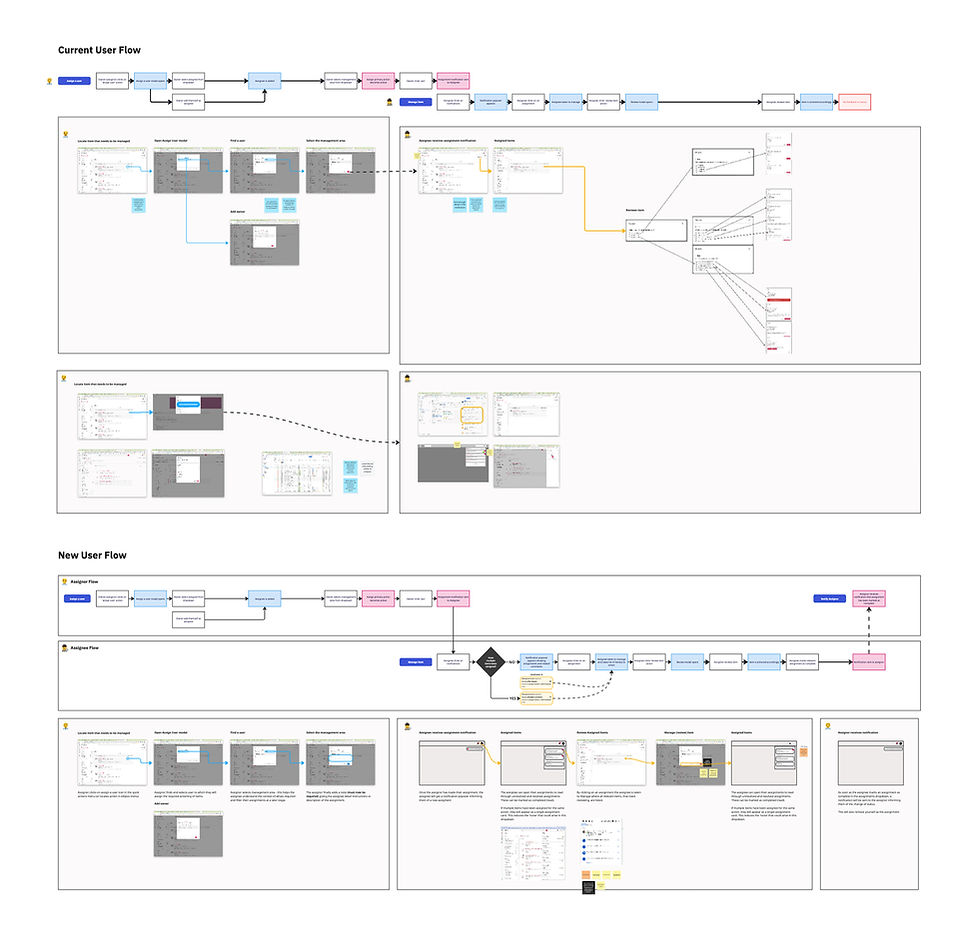
To ground design decisions in evidence, I led a focused discovery phase with cross-functional stakeholders and mapped the current state of assignments in Workplace AI.
Workflow Mapping
I decomposed the existing assignments flow by:
-
Identifying touchpoints between assignor and assignee,
-
Documenting information passed at each step,
-
Highlighting where context was missing or ambiguous.
This revealed systemic gaps: notifications often lacked key details (e.g., assignment rationale, relevant document context), and assignees couldn’t easily act without further clarification.

Heuristic Review
I benchmarked against task management systems and collaborative platforms to understand patterns for assignment communication, task summaries, and notification cues. This highlighted industry best practices around contextual notification text, persistent task summaries, and clear action pathways.
Heuristic Review
Regular conversations with engineering and system architects illuminated technical constraints — particularly that the foundational assignment infrastructure already existed, but was tightly coupled with the notification system. A more robust “assignment hub” UI was a longer-term initiative, but we saw an opportunity to improve clarity within notifications as an interim tactical improvement.
Design Execution
Redefined Notification Experience
Rather than approaching this as a standalone feature redesign, we re-focused the problem: notifications were the primary surface of task communication. Therefore, improving how assignments are communicated meant improving notification content, structure, and behaviour.
Key design decisions included:
-
Rich Context Cards: Expand notification templates to include document metadata, assignment intent, and clear next steps.
-
Role-Sensitive Messaging: Different wording and visual emphasis for assignors and assignees to signal ownership and actionable items.
-
Journey Intro Cards: When presenting the prototype to stakeholders, we added intro cards to explain shifts in user context through the journey — helpful for aligning cross-discipline collaborators.
These details were captured in Figma as a fully interactive prototype that conveyed changes not just visually, but in flow logic.

Collaboration & Validation
Design refinement involved iterative workshop sessions:
-
Design reviews with peers and heads of engineering,
-
Co-ideation with product managers to prioritise messaging types,
-
3-Amigos handoff sessions to align on implementation risks and story splits.
This collaborative rhythm ensured feasibility without diluting usability intent.
Handover
Before development, I led:
-
A comprehensive 3-Amigos session to synchronize onboarding of design artefacts,
-
Story decomposition into implementation tickets,
-
Annotated interaction specs that illustrated edge cases and notification contexts.
This groundwork reduced ambiguity in developer execution and eased implementation velocity.

Impact & Outcomes
Experience Improvements
-
Increased clarity: Assignees now receive context-rich notifications that clearly articulate what needs to be done and why.
-
Reduced friction: Users spend less time chasing context or clarifying via follow-ups.
-
Greater confidence: Assignors feel assured that expectations are communicated effectively.
Business Value
These improvements strengthened Workplace AI’s assignment management positioning — bringing it closer to market norms for task-oriented workflows and improving key adoption vectors for enterprise customers.
Immediate Feedback
User feedback after launch was significantly more positive, with assignees reporting better understanding of tasks and stakeholders noting increased trust in the assignment workflow.
Reflection & Lessons Learned
Solve for Communication, not just UI
This project reinforced that at enterprise scale, assignments and notifications are strategic communication tools, not just interface elements. Embedding context and intent into UX reduces cognitive load and improves collaboration.
Leverage Existing Infrastructure
Given technical constraints, enhancing existing notification systems was a high-leverage move — delivering meaningful user value without requiring backend overhaul.
Alignment Across Teams
Early and frequent alignment with engineers and product managers ensured design feasibility and reduced the number of iteration cycles.
Iterative Prototyping Speaks Louder Than Wireframes
Even for relatively low-effort UI tasks, high-fidelity prototypes with clear messaging strategy enabled stronger stakeholder alignment and smoother handoffs.
Next Steps
The next phase of this work stream would encompass three key areas:
-
A central Assignment Hub UI where users can view, sort, and act on all outstanding assignments.
-
Analytics on assignment engagement (opened vs acted upon).
-
Role-specific dashboards for assignors to track completion status and follow-ups.
Continue Exploring...

SaaS Product Feature Design
Research and design exploration for an intelligent insights panel in Workplace AIs Enterprise Search.

SaaS Product Feature Design
Using an AI chatbot and configured agentic models to efficiently deliver customer subject access requests.